Account Terminated? The Legal Realities of YouTube’s Circumvention Policy and Compliant Paths to Recovery
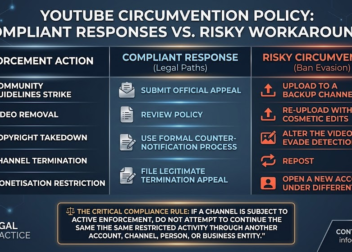
YouTube’s circumvention policy is designed to prevent users from avoiding, bypassing, or undermining the platform’s enforcement actions. If YouTube removes content, restricts a channel, suspends features, or terminates an account, the affected creator is generally prohibited from using workarounds to continue the same activity. In practical terms, this means a creator should not create a new channel, use another person’s channel, re-upload removed content, or shift activity to an alternate account in order to avoid YouTube’s prior enforcement decision. YouTube’s official policy states that posting content previously removed for violating its Terms of Service, posting content from creators with current channel restrictions, or posting content from terminated creators may be treated as circumvention. YouTube further states that such content may be removed and that the relevant channel, including other channels owned by the same person, may be penalised or terminated. What Does “Circumvention” Mean on YouTube? On YouTube, “circumvention” means taking steps to defeat the practical effect of a restriction, penalty, or enforcement action. Rather than accepting the restriction or using YouTube’s official appeal process, the creator attempts to continue the same activity through another route. Common examples include: Why YouTube Enforces Circumvention Rules The policy exists because enforcement actions would have little effect if creators could simply move prohibited activity to another channel. YouTube uses its rules to protect users, advertisers, copyright owners, and the integrity of the platform. The circumvention policy helps YouTube: The Operational Reality: How YouTube May Detect Evasion Creators sometimes assume that using a new email address, channel name, or brand identity is enough to separate a new channel from a penalised one. That assumption is risky. YouTube may consider various account, ownership, behavioural, and content-related signals when enforcing platform rules. While YouTube does not publicly disclose every detection method, creators should assume that related channels, repeated uploads, shared ownership structures, reused content, and common account infrastructure may be reviewed. A simplified enforcement pathway may look like this: Prior enforcement event↓Channel restriction, content removal, demonetisation, or termination↓Creator uses another channel, account, or third party to continue the same activity↓YouTube identifies the conduct as evasion or reposting↓Secondary enforcement against the new or related channel The key point is not merely whether the creator used a different account. The central issue is whether the creator is trying to avoid the effect of YouTube’s original enforcement decision. Critical Situations Where Circumvention Frequently Occurs 1. The “Backup Channel” Problem Many creators maintain backup channels. A backup channel is not automatically improper. However, if the main channel is restricted or terminated and the creator immediately uses the backup channel to continue the same prohibited activity, YouTube may treat the backup channel as part of the circumvention attempt. A backup channel should not be used to: 2. The “Prominently Featured Creator” Risk A terminated creator may also create risk for other channels if they continue appearing as the central personality, host, or driving force behind content on another channel. If the practical effect is that the terminated creator has returned to YouTube through a different channel, the host channel may face scrutiny. This is particularly relevant for: 3. Reposting Removed Content YouTube’s official policy expressly states that posting content previously removed for violating its Terms of Service may be considered circumvention.[^1] This means creators should be cautious before re-uploading: If the original issue has not been resolved, re-uploading the content may worsen the enforcement outcome. 4. Copyright-Related Circumvention Copyright enforcement is a particularly sensitive area. Creators should distinguish between: Trying to avoid copyright systems by altering pitch, mirroring footage, cropping images, speeding up video, or disguising copyrighted material can create serious platform risk. If a creator believes a copyright claim or takedown is wrong, the proper route is to use YouTube’s dispute or counter-notification process rather than attempting to re-upload around the claim. 5. Monetisation and AdSense Evasion Circumvention can also arise where a creator attempts to avoid monetisation restrictions. For example: These steps may be viewed as attempts to avoid the consequences of YouTube’s enforcement decision. Legitimate Responses vs. Illegitimate Workarounds When a creator receives a strike, restriction, takedown, or termination notice, the safest path is to use YouTube’s official review procedures. The Golden Rule of Platform Compliance If a channel is under active enforcement, do not attempt to continue the same restricted activity through another account, channel, person, or business entity. The proper sequence is: What Creators Should Do If They Receive a Strike or Termination Creators should take a structured approach: 1. Read the enforcement notice carefullyIdentify whether the issue concerns Community Guidelines, copyright, monetisation, spam, impersonation, harmful content, or another policy area. 2. Preserve evidenceKeep copies of: 3. Do not re-upload immediatelyRe-uploading removed content is one of the clearest ways to trigger a circumvention allegation. 4. Use the correct appeal routeDifferent issues require different procedures. A copyright dispute is not the same as a Community Guidelines appeal. A monetisation review is not the same as a termination appeal. 5. Audit related channelsIf the creator owns or controls multiple channels, those channels should be reviewed to ensure they are not reposting removed content or continuing restricted conduct. 6. Update internal compliance practicesFor businesses, agencies, and production teams, channel managers should be trained on YouTube’s rules. Many enforcement issues arise because editors, contractors, or social media staff continue posting content without understanding the restriction. What If YouTube’s Decision Is Wrong? YouTube enforcement is often automated or semi-automated. Mistakes can occur. A creator may believe that a termination, strike, takedown, or demonetisation decision was incorrect. Where that happens, the creator should focus on formal remedies rather than workarounds. These may include: For Canadian and Ontario-based creators, disputes with YouTube may involve a combination of contract law, platform terms, copyright law, consumer protection considerations, and cross-border jurisdictional issues. The governing terms, forum clauses, and applicable law provisions in YouTube’s Terms of Service are highly relevant. Potential Legal Issues for Commercial Creators Where a terminated or demonetised channel is a major business asset, the legal issues may extend beyond ordinary platform